Extended Warranty for Consumer Electronics – How Retailers Increase Customer Satisfaction and Revenue

Why the Legal Warranty Alone Is Not Enough
In the EU, the legal warranty period is two years. During this time, sellers are liable for material or manufacturing defects that already existed at the time of delivery. After these two years, customers can no longer make statutory warranty claims.
Most consumers are generally aware of this fact, but many underestimate the sudden risk that arises as soon as the legal minimum period ends. The frustration is correspondingly great when repairs have to be paid for shortly after the warranty period expires, even though the same defect would have been covered by the legal warranty just a few weeks earlier. For retailers, this often results in a loss of trust that has less to do with the actual product quality than with disappointed customer expectations.
An extended warranty – also known as a long-term warranty – can provide a targeted solution here and ensure additional security beyond the minimum period required by law.
What Is an Extended Warranty?
An extended warranty clearly defines what remains covered after the legal warranty expires, under which conditions coverage applies, and how long the protection lasts.
Core benefits typically include coverage for material and manufacturing defects that may occur even after the initial two-year period. In the event of a valid claim, repair or replacement costs are covered. Depending on the pricing model, coverage may be fully comprehensive or include a deductible. If repair is no longer economically viable, customers receive reimbursement based on the device’s current value. This creates reliability for customers and planning certainty for retailers.
Terms, Additional Services, and Use Cases
Extended warranties offer flexible terms ranging from a few months to several years. Depending on the product category, retailers may offer additional services, such as battery replacement if the performance of the original battery falls below a specified threshold. These clearly defined additional options increase transparency and make the scope of services easy to understand. A warranty extension can apply not only to new goods, but also to professionally reconditioned, refurbished devices. In this area in particular, extended warranty protection provides additional security and helps to reduce possible reservations about used goods.
How Customers Purchase an Extended Warranty
Ideally, purchasing an extended warranty should be kept deliberately simple for customers and fully integrated into the purchasing process. The additional service can either be purchased directly together with the electronic product or subsequently within a specified period and activated digitally. This allows customers to decide for themselves when and to what extent they want to use the additional protection.
The extended service then begins automatically after the legal warranty expires, without the need for re-registration or further action. If damage occurs during the additional term, it can be conveniently reported online via a customer portal.
How Retailers Benefit from Extended Warranties
Extended warranties are no longer just a service promise – they are increasingly becoming a measurable growth driver throughout the entire customer journey.
Key benefits include:
- Higher conversion rates: Protection plans reduce purchase hesitation and simplify decision-making.
- Increased revenue: Warranty options drive upselling and increase average order value.
- Recurring commissions: Each contract generates upfront income and ongoing commission streams.
- Stronger customer retention: Customer relationships extend beyond the initial sale and continue throughout the coverage period.
- Enhanced brand perception: Offering extended protection signals quality, reliability, and service excellence.
Some retailers even offer extended warranties at no additional cost. In this model, they absorb a fixed fee per device and position the warranty as a value-added benefit within the purchasing decision. The result: customers receive comprehensive protection at no extra charge, while retailers benefit from higher sales volumes and increased trust. In highly competitive markets, this can become a true differentiator.
Discover how you can seamlessly integrate an extended warranty into your existing sales process. 👉🏼 Book a meeting with Felix, our expert for insurance solutions.
Insurance vs. Extended Warranty – What’s the Difference?
Although often used interchangeably, extended warranties and insurance products serve different purposes. An extended warranty focuses on the functional integrity of the product itself, covering material and manufacturing defects. An insurance policy, on the other hand, protects against external risks such as accidental damage or theft, including drops and liquid damage.
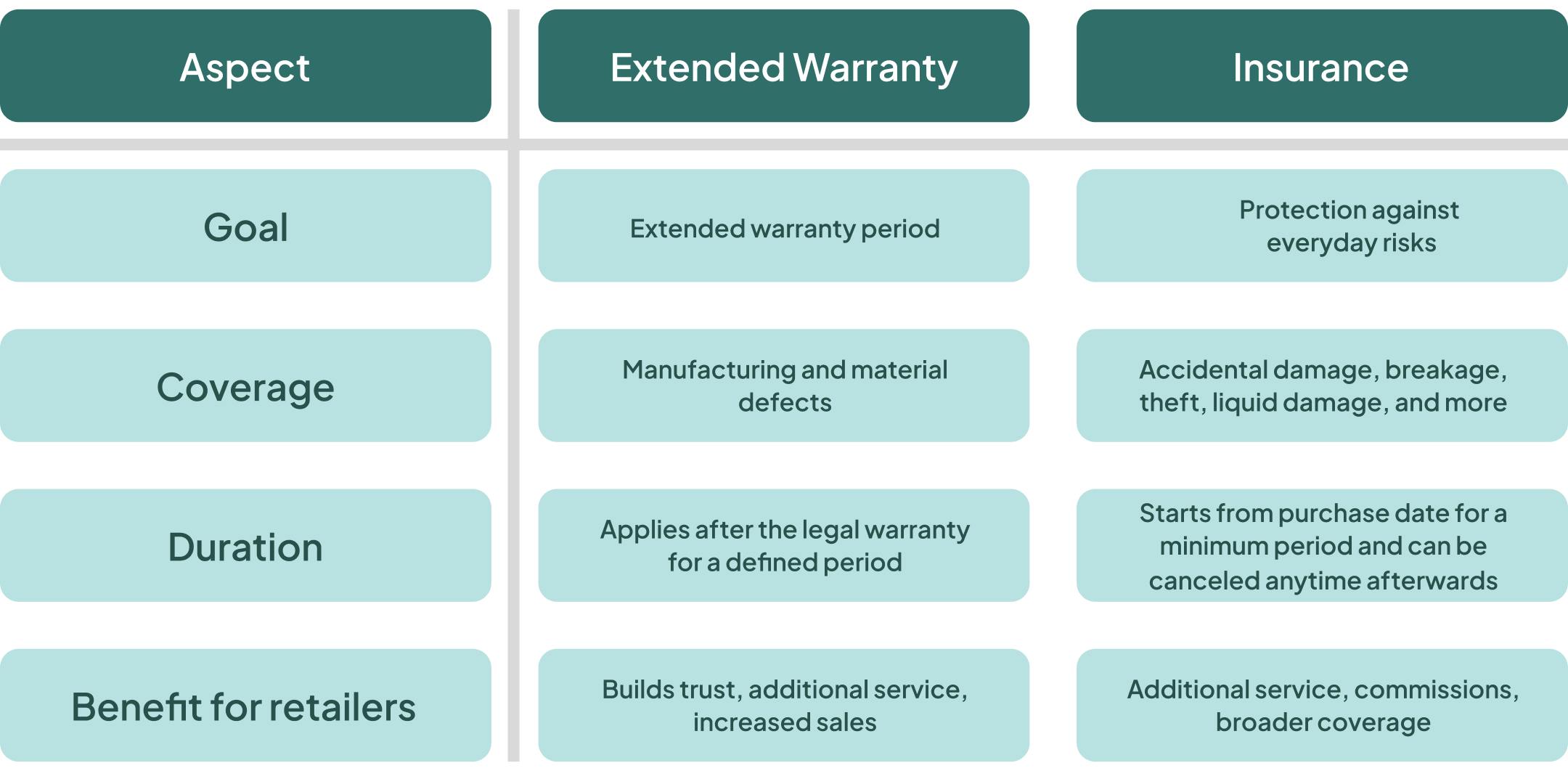
In practice, it is not about choosing one over the other, but about combining both strategically. Each solution addresses distinct customer needs and fulfills a clearly defined role within a comprehensive protection offering.
Transparent Terms as the Foundation of Trust
For an extended warranty to truly deliver on its promise, precisely defined and transparently communicated terms and conditions are essential. They establish a shared understanding between manufacturers, retailers, and end customers – an aspect that is particularly critical in multi-tier distribution structures.
The terms clearly specify which services are provided in the event of a claim, which coverage periods apply, and what documentation requirements must be met. Damage resulting from improper handling, external influences, or normal wear and tear is typically excluded.
By clearly distinguishing between valid and invalid warranty claims, misunderstandings can be avoided, complaints reduced, and service processes handled more efficiently. At the same time, this transparent framework enhances legal certainty for all parties involved and strengthens trust in both product quality and the retailer.
Digital Integration with hepster – Simple, Flexible, Automated
With hepster, warranty extensions can be digitally integrated into existing sales processes in just a few steps. Regardless of whether the sale takes place online, via partners, or directly at the point of sale.
For retailers, this means:
- Flexible product configuration: Extended warranties and insurance solutions can be tailored to specific product portfolios and target audiences.
- Automated management: All processes run via an API, completely without any additional manual effort.
- Real-time activation: Coverage is activated instantly at checkout, ensuring seamless protection.
- Digital customer experience: Customers can view and manage all protection products online at any time.
The result is an efficient after-sales service model that pays off: reduced administrative effort, stronger customer loyalty, and demonstrably higher revenue.
Conclusion – More Protection, More Trust, More Revenue
Today, an extended warranty is far more than an optional add-on. It is a strategic instrument for sustainable customer retention, stronger brand trust, and competitive differentiation. Whether offered as a paid add-on or as an integrated value-added service, it enhances security, provides clarity, and improves the overall purchasing experience beyond the point of sale.
Combined with complementary insurance solutions, retailers can create a comprehensive protection ecosystem that benefits both sides: Customers gain long-term peace of mind, while retailers strengthen their brand image, service quality, and revenue performance.
Every product sold becomes a promise of security, trust, and long-term customer satisfaction.
Talk directly to Felix
Felix will show you in a short conversation how you can easily integrate bike insurance into your online shop.